
Are We Underloading Accessory Exercises?
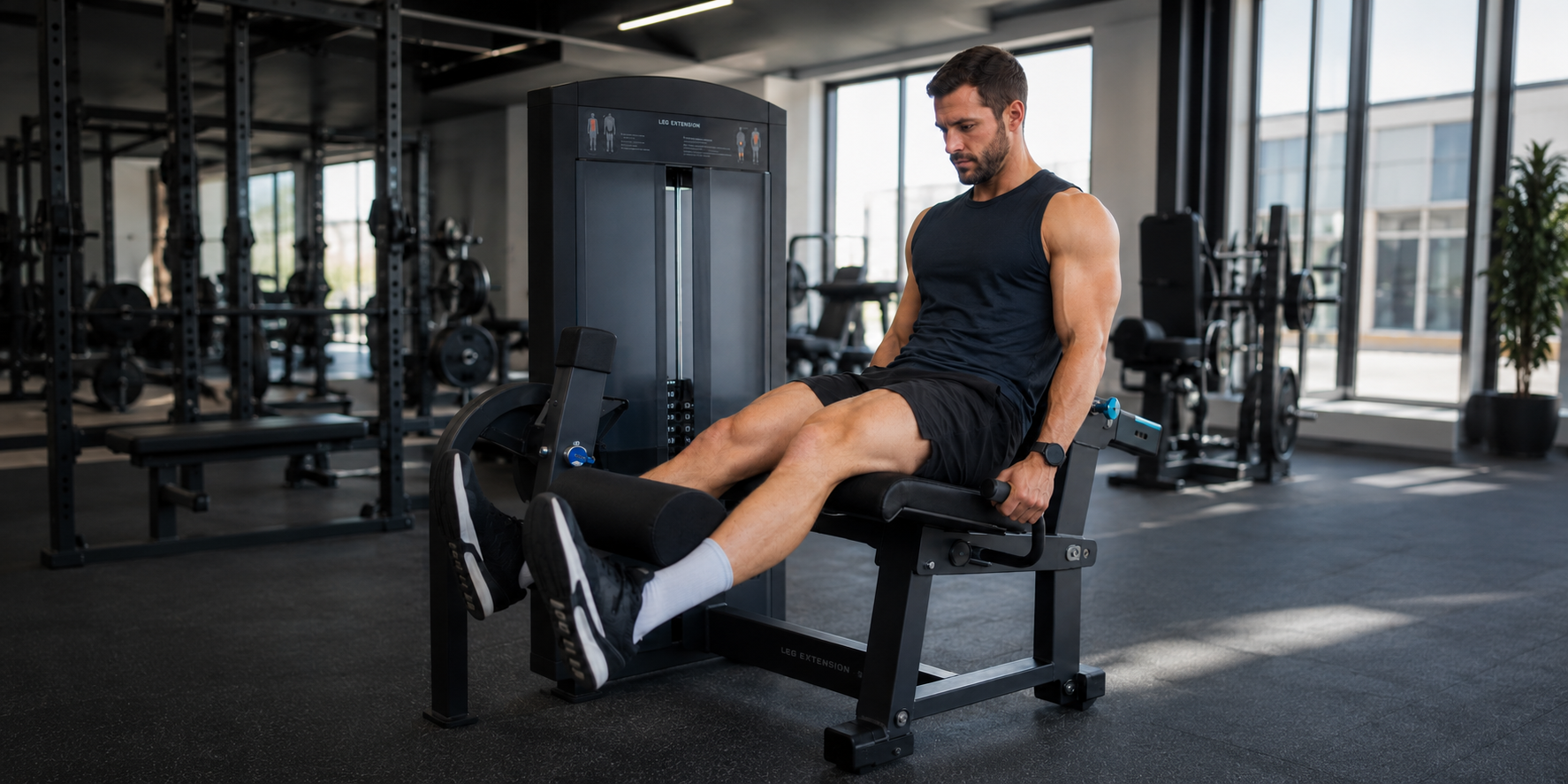
Table of Contents
1 The Strange Status of Accessory Work
2 When Muscle Gain Is No Longer the Easy Answer
3 The Leg Extension Problem
4 The Real Question
References
1 The Strange Status of Accessory Work
In powerlifting, accessory exercises occupy a strange position. They are included because they are supposed to matter, yet rarely programmed with the same precision as the competition lifts. Squats, bench presses and deadlifts receive percentages, RPE targets, velocity thresholds and technical analysis. Accessories, by contrast, often become “3 × 10–15” because the coach wants more volume.
That may be appropriate when the goal is hypertrophy, tolerance or general development. Higher repetitions can create local fatigue, add useful volume and reduce the systemic cost of more heavy squatting, benching or deadlifting. The problem is not high-repetition training itself. The problem is assuming that accessory work belongs there by default.
If an accessory exercise is prescribed to improve maximal strength, the loading deserves more scrutiny. A leg extension written as “3 × 15” may be fine for general quadriceps hypertrophy. But if the claim is that it addresses knee-extensor limitations in the squat, this becomes a transfer claim, not a vague bodybuilding prescription. And once a transfer claim is made, loading matters.
A maximal squat is not a test of whether the quadriceps can tolerate discomfort for fifteen repetitions. It is a single maximal expression of force under specific mechanical and technical constraints. If the knee extensors are genuinely part of the limitation, the question is not only, “Can we make them bigger?” The better question is: “Can they produce more force where the squat demands it?”
2 When Muscle Gain Is No Longer the Easy Answer
This distinction matters because hypertrophy and maximal strength are related, but not identical. A larger muscle may increase strength potential, but potential is not performance. Muscle mass gives the athlete more machinery, but it does not guarantee that the machinery can be used effectively under a maximal barbell. Strength is not simply muscle mass wearing a singlet.
This becomes even more important in a weight-class sport. Hypertrophy is valuable, but it is not an unlimited solution. A lifter near the top of their class cannot treat muscle gain as a neutral recommendation. More mass may improve strength potential, but it may also require a harder weight cut, alter leverages, compromise recovery, or force the athlete into a more competitive weight class. Tromaras et al. (2024) found that changes in lean body mass were strongly associated with changes in powerlifting performance during competition preparation, but this should not be reduced to “just get bigger”. For the weight-class athlete, the harder question is not whether muscle matters. It clearly does. The harder question is how much more force can be expressed with the body mass already available.
This is where accessory work becomes more interesting. If an athlete has limited room to gain body mass, accessory training cannot always be justified as general hypertrophy work. At some point, the programming question shifts from building more tissue to improving force expression with the tissue already present. That may require accessory exercises to target specific aspects of maximal strength: force production at certain joint angles, positional strength, lockout capacity, or the ability to produce high force without excessive fatigue.
The recent dose-response literature sharpens this argument. Pelland et al. (2025) suggest that strength may show earlier diminishing returns from additional weekly set volume than hypertrophy. This is important because strength is not merely a tissue-building outcome. It is also a skill- and fatigue-sensitive expression of force. Early sets may provide meaningful practice, neural stimulus and exposure to the tested movement. Additional sets may still contribute something, but they may increasingly add fatigue or less specific work rather than a proportionate increase in maximal strength.
That does not mean volume is unimportant. It means that “more work” and “more useful strength stimulus” are not always the same thing. A lifter may perform more squat volume, but if technique deteriorates, bracing fatigue accumulates and bar path changes, the additional sets may no longer overload the intended limitation. The athlete is not necessarily becoming more specific. They may simply be becoming more tired.
Hypertrophy may continue responding to volume after strength has already begun to plateau. That is the trap. More hard sets may still build tissue, but that does not mean they continue to improve maximal strength at the same rate. The mistake is assuming that the set which grows the muscle automatically teaches the muscle to be strong.
Robinson et al. (2024) add another important layer. Their meta-regressions suggest that proximity to failure appears more clearly related to hypertrophy than to strength, whereas maximal strength seems less dependent on how close sets are taken to failure. For accessory work, this distinction matters. A light leg extension taken to failure may be hard. It may burn. It may provide a useful hypertrophic stimulus. But hard because of fatigue is not the same as hard because of high force demand.
This is a distinction powerlifting coaches should take more seriously. A repetition can feel difficult because the load is heavy, or because the athlete is exhausted. Those are not identical stimuli. Hypertrophy may be more willing to accept fatigue as part of the price. Maximal strength is more selective. It asks not only whether work was done, but whether the right force was produced, in the right context, with enough quality to be expressed later.
3 The Leg Extension Problem
Take the leg extension again. If a lifter repeatedly loses speed around a similar knee angle in the squat, and the coach has reason to believe knee-extensor force is part of the limitation, then a generic set of fifteen may not be the only logical prescription.
A heavier partial or isometric leg extension near the relevant joint angle may allow the athlete to overload local knee-extensor capacity more frequently and with less systemic cost than additional heavy squatting. This would not prove transfer. It would not make the leg extension “specific” in the full sporting sense. But it may be a defensible coaching hypothesis.
This is where dynamic correspondence is useful. A leg extension is not a squat. It lacks axial loading, trunk rigidity, hip-knee coordination, balance, foot pressure and the exact force-vector demands of the competition lift. Larsen et al. (2021) showed that the sticking region in the back squat is biomechanically complex, involving changes in joint kinematics, kinetics and muscle activity rather than a simple isolated quadriceps failure. Therefore, the leg extension should not be sold as a magic solution.
However, dynamic correspondence does not force us to choose between perfect specificity and uselessness. Verkhoshansky and Siff (2009) argued that transfer should be considered through factors such as movement amplitude and direction, the accentuated region of force production, dynamics of effort, rate and timing of force production, and the regime of muscular work. Under this framework, the leg extension has poor global correspondence to the squat, but it may offer local correspondence: knee-extension force, high quadriceps tension and loading near a joint angle of interest.
That distinction matters. The leg extension does not replace the squat. It may build a local resource that must later be integrated through more specific work. But dismissing it because it is not fully specific misses the point. Sometimes the specific lift is too complex, too fatiguing or too technically noisy to keep adding high-quality stress to one structure. An accessory exercise can act as a volume bypass.
4 The Real Question
This exposes a contradiction in powerlifting culture. We obsess over specificity, then programme accessories by tradition. We claim a triceps extension will help lockout strength, then load it as if force production is irrelevant. We claim a leg extension will help the squat, then use it only as a finisher. We claim accessories address weak points, but often refuse to ask whether the loading actually matches the weakness.
Perhaps the problem is the word “accessory” itself. It sounds secondary, optional, almost decorative. But an exercise is not less important because it comes later in the session. It is less important only if its purpose is less important. Sometimes an accessory lift is just extra work. Sometimes it is the most targeted solution to a performance problem.
This does not mean every accessory should become a five-repetition maximum. Heavy lateral raises are probably not the future of powerlifting. Heavy isolation work can irritate joints, increase fatigue and interfere with the main lifts if programmed carelessly. Some accessories are valuable precisely because they allow hard local work without the arousal, risk or systemic cost of heavy compound lifting.
But the repetition range should follow the purpose of the exercise. If the purpose is hypertrophy, higher repetitions may be appropriate. If the purpose is tissue tolerance, higher repetitions may make sense. If the purpose is variation or adherence, load may not be the central variable. But if the purpose is to improve maximal force production in a muscle group believed to limit a competition lift, heavier accessory work deserves a place in the conversation.
So, are we underloading accessory exercises in powerlifting?
Sometimes, yes. Not because high repetitions are wrong. Not because hypertrophy does not matter. Not because accessory lifts should imitate the competition lifts. But because many accessories are loaded according to habit rather than intent. Coaches are often meticulous with the main lifts and vague with everything else. That may be acceptable when the goal is general development. But if the goal is strength transfer, vague is not good enough.
Accessory work should not merely make the athlete tired, sore or pumped. It should assist. And if it is meant to assist a sport built around one maximal repetition, we should at least ask whether the exercise is loaded heavily enough to do the job we expect from it. The real question is not whether leg extensions should be performed for five reps or fifteen. The real question is more uncomfortable: Do we actually know why they are in the programme?
References
Larsen, S., Kristiansen, E., & van den Tillaar, R. (2021). New insights about the sticking region in back squats: An analysis of kinematics, kinetics, and myoelectric activity. Frontiers in Sports and Active Living, 3, Article 691459. https://doi.org/10.3389/fspor.2021.691459
Pelland, J. C., Remmert, J. F., Robinson, Z. P., Hinson, S. R., & Zourdos, M. C. (2025). The resistance training dose response: Meta-regressions exploring the effects of weekly volume and frequency on muscle hypertrophy and strength gains. Sports Medicine. https://doi.org/10.1007/s40279-025-02344-w
Robinson, Z. P., Pelland, J. C., Remmert, J. F., Refalo, M. C., Jukic, I., Steele, J., & Zourdos, M. C. (2024). Exploring the dose–response relationship between estimated resistance training proximity to failure, strength gain, and muscle hypertrophy: A series of meta-regressions. Sports Medicine, 54, 2209–2231. https://doi.org/10.1007/s40279-024-02069-2
Tromaras, K., Zaras, N., Stasinaki, A.-N., Mpampoulis, T., & Terzis, G. (2024). Lean body mass, muscle architecture and powerlifting performance during preseason and in competition. Journal of Functional Morphology and Kinesiology, 9(2), Article 89. https://doi.org/10.3390/jfmk9020089
Verkhoshansky, Y., & Siff, M. C. (2009). Supertraining (6th ed.). Verkhoshansky SSTM.